
About pigments

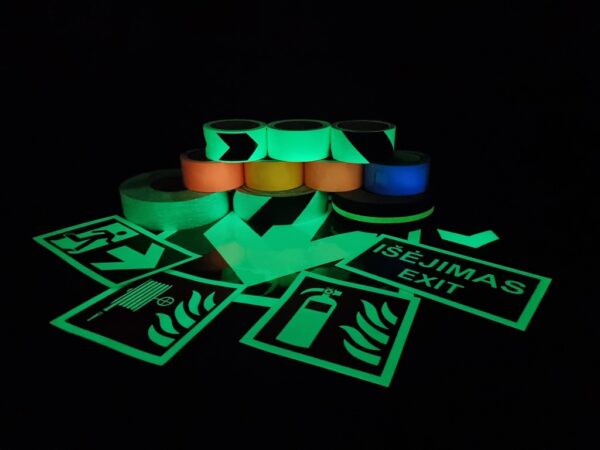
Photoluminescent pigment is a kind of rare earth photoluminescent powder, containing no radioactive component. After absorbing different types of light (visual light, sunlight, lamp light, UV light), it can store the energy and start glowing in the darkness. This process of light-absorption and light-emission can be repeated constantly for many years. Pigments can be used as an additive into the transparent agents: varnishes, coating, paint, plastics, silk-screen printing ink, glass, enamel, silicon rubber, fiber, etc.

These pigments take on their natural colour in the light and emit different colour of lights in the darkness. The photoluminescent pigments can be safely applied in production of daily consumables: apparel, footwear, stationery, switch, fishing kits, plug, lock, electric torch, etc.

The pigments are very important in the fields of safety: emergent lighting and indication marks. Pigments are used for producing light-absorbing and light emitting luminescent marks: emergency escape indication, fire protection security indication, electric power security indication, marine security indication, etc. The luminescent signs and markings are widely applied in supermarkets, elevators, hospitals, emergency passenger way, subway station, underground passages, archives, subways, underground car parkings, cinemas, theatres, night clubs, etc.

Photoluminescent pigments can also be applied in daily life. They are non-toxic and non-radioactive, non-detrimental to people health, environment friendly. The pigments can be safely used in interior decoration, paintings, arts and crafts decoration, bicycle decoration, etc.

Photoluminescent pigments immediately absorbs the UV light and glows very brightly in the dark. It is enough for them to get the UV light  just for a few seconds. The glowing of the pigments lasts about 12 hours depending on the type of pigment.

Classification, chemical and physical properties

Photoluminescent pigments, selled by our company „Narvita“, are classified into seven groups: A, B, C, D, E, F, G. The pigments differs among each other by chemical properties, which determine different physical properties and application possibilities of the pigments.

  • A group pigments (excluding P-05 ir P-10) have high illuminating brightness and long-lasting (more than 12 hours) glowing in the darkness;
  • B group pigments are bright in colour and fast in light absorption; due to raw material of sulfide, the pigments have unpleasant smell;
  • C group pigments have high chemical stability and brightness (short-term), water resistance; soluble in organic solvents;
  • D group pigments have high colour brightness in daytime and night time; 
  • E group pigments are waterproof, has high chemical stability; applicable to organic solvents;
  • F group pigments have high illuminating brightness and long-lasting (more than 10 hours) glowing in the darkness; one of this group pigment P-24 contains very small particles (size 5-8 um) – because of this property, pigment P-24 is applied in silk-screen printing, fiber, textile, etc.;
  • G group pigments have high colour brightness in daytime and night time; should be used indoor, not outdoor;

The pigments belonging to the same group differs among each other in particles‘ size, which influence the intensity of illuminating brightness. E.g., pigment P-20, belonging to group F, contains particles 15-25 um and the pigment P-21 contains particles 20-50 um. In this case, pigment‘s P-21 brightness intensity is higher and P-20 – lower. The selection of photoluminescent pigment depends on its application field. E.g., the pigments with very small particles are applied in silk-screen printing, the pigments containing larger particles can be used in markings of fire-protection indications.

Notes for the application of pigments

  • Most of the photoluminescent pigment are less soluble in water and decomposed in acid, so they can not be applied in water-base or acid-base series except specific remarks;
  • It is important to mix pigment well before using in terms of its gravity;
  • Keep pigments in breezy, dry warehouse and make it free from humidity. Pack the rest pigment carefully after one time usage.
  • Metal materials influence pigments, so avoid the pigments from touching metal material.

Certification

Photoluminescent pigments sold by our company meets the requirements of ISO 9001:2008, DNV and TÜV Rheinland. The certifications for production issued are guarantee of quality and safety for human and environment.